


Asbestos Surveyors UK

Where It Hides

Protecting Yourself & Others

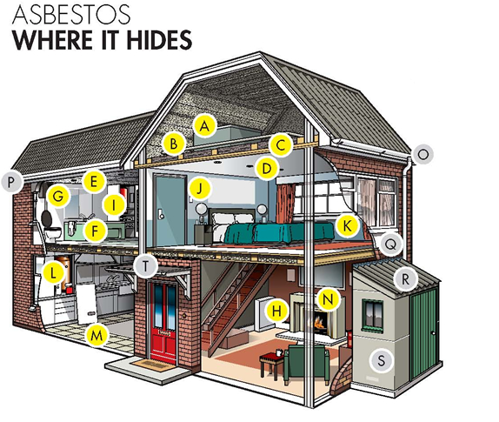
Where it Hides

Asbestos can hide in many places

A. Asbestos cement water tank
B. Pipe lagging
C. Loose‑fit insulation
D. Textured decorative coating (Artex)
E. AIB ceiling tiles
F. AIB bath panel
G. Toilet seat and cistern
H. AIB behind fuse box
I. AIB in airing cupboard or sprayed insulation on boiler/hot water tank
J. AIB partition wall
K. AIB interior window panel
L. AIB around boilers, storage heaters and warm‑air heating systems
M. Vinyl floor tiles
N. AIB behind fireplace
O. Asbestos cement gutters and downpipes
P. Asbestos cement or AIB soffits
Q. AIB exterior window panel
R. Asbestos cement roof
S. Asbestos cement panels
T. Asbestos in roofing felt

Some asbestos‑containing materials are far more hazardous than others. Loose‑fill insulation (85% asbestos) is extremely dangerous because it easily releases fibres into the air. By contrast, asbestos cement contains up to 15% asbestos and only becomes a risk if cracked, damaged or disturbed.

Who is at risk?
• Tradespeople — most likely to disturb asbestos during maintenance or repairs
• Residents — exposed if damaged asbestos releases airborne fibres
• Landlords — at risk if carrying out DIY repairs or unaware of hidden asbestos

No asbestos material poses an immediate threat unless it is damaged or disturbed. A qualified asbestos management survey is the only way to confirm whether asbestos is present and assess its condition.

Asbestos Can Hide in These Materials

  • Water tanks
  • Pipe lagging
  • Loose-fill insulation 
  • Textured coating (like Artex)
  • Ceiling tiles
  • Floor tiles
  • Around boilers and other heating products
  • Partition walls 
  • Window panels
  • Toilet seats and cisterns
  • Gutters and soffits
  • Roofs
Surveys

Do You Need an Asbestos Management Survey?

Asbestos was used in building materials for around 100 years. If your property was built before 2000, then it is likely to contain asbestos. 
This means you’ll have a legal duty to find out where it is and put plans and measures in place to manage it. 
Therefore, it’s a good idea to get a qualified surveyor to carry out an asbestos management survey. There are two types of assessment:
  • Asbestos management survey: This is generally used when asbestos has already been identified. The surveyor will inspect the asbestos and provide advice on its condition, how to monitor it and what, if any, action should be taken. 
  • Refurbishment and demolition survey: If you plan to carry out any construction work on a pre-2000 property, you should get one of these surveys. The aim is to find where asbestos is present in your property. The surveyor will have to take samples and access closed-off spaces (like inside cavity walls) to inspect the building. This can cause damage to the building.
Free Checklist​

Checklist for Keeping Your Property Asbestos-Safe

You should always use an expert when dealing with asbestos. Never attempt to assess or deal with it yourself. 
However, there are some initial steps you can take to ensure you fully understand your property’s asbestos risk.

Find out if you have asbestos


✔️ Was your building built before 2000? If so, then assume it has asbestos.
✔️ Examine any documents that may indicate the presence of asbestos – for example, tradespeople reports. 
✔️ Perform a visual check for any potential asbestos both inside and outside of the property.

✔️ Record your findings.

Assess the condition of asbestos


✔️ Try to estimate how much asbestos you have and what condition it is in. Look out for the following warning signs:
  • Damaged, frayed or scratched surfaces
  • Seals peeling or breaking off
  • Asbestos becoming detached from a base
  • Missing or damaged protective coverings
  • Asbestos dust from damage
Get a survey

 ✔️ Next it’s time to find a suitably qualified person to carry out an asbestos survey. The type they perform depends on whether you are planning construction work on the property or not.

Keep a record and make a plan
✔️ Record details of what asbestos the survey found, including:
  • Where it is 
  • What condition it is in
  • What type of asbestos it is

✔️ Write down your plan for managing the asbestos.

✔️ Make sure the record and plan is accessible to you, your tenants, tradespeople and anyone else who may need it. 

Implement your plan

Give your asbestos record and plan to any new tenant who moves in or tradesperson who works at the property. 

✔️ Clearly label anything that contains asbestos so people who come across it know what it is.

✔️ If your property has asbestos then the assessor may decide that it could release fibres in the normal course of someone living there or a tradesperson working there. If this is the case, you will need to hire a specialist to remove it.

Monitor and review

✔️ Reinspect any asbestos once per year.

✔️ Review your asbestos action plan annually and make appropriate changes to it.